

Your time is best spent with patients, not buried under a mountain of paperwork. Yet, the administrative burden only grows, and the endless cycle of hiring, training, and managing staff is a major roadblock to scaling your practice. This operational drag is precisely why so many successful practices are turning to virtual medical assistant companies for a strategic advantage. But with the market expanding, how do you separate a reliable, HIPAA-compliant partner from a solo contractor who could leave you stranded on a sick day?
Choosing the right partner is the critical first step to reclaiming your focus and achieving scalable growth. This guide cuts through the noise. We will explore the different types of virtual medical assistant services available and provide a definitive checklist for selecting a partner that guarantees 100% operational continuity and ironclad security. Get ready to discover how you can slash administrative overhead by 60% or more and finally scale your practice without the staffing headaches.
The Landscape of VMA Companies: Not All Support is Created Equal
Administrative overload is crippling modern medical practices. The endless cycle of paperwork, patient communication, and insurance verifications drains valuable time, pulling focus away from patient care and hindering practice growth. While many leaders turn to virtual medical assistant companies for a solution, they quickly discover that the term "virtual support" covers a vast and inconsistent landscape of services and delivery models.
The industry has evolved significantly. Initially, practices sought to replicate the role of a traditional in-office medical assistant by hiring individual freelancers. Today, the most strategic practices are moving beyond simple task delegation and partnering with professional services that offer comprehensive, reliable administrative support. The goal is no longer just to offload work. It's to build a resilient operational backbone that can scale on demand.
Common Services Offered by VMA Companies
A capable virtual medical assistant can manage a wide spectrum of responsibilities, which are typically grouped into three key areas:
- Front-Office Tasks: Includes appointment scheduling, patient intake and registration, and managing incoming calls as a virtual receptionist.
- Back-Office Tasks: Focuses on administrative duties like insurance eligibility verification, prior authorizations, and medical billing and coding support.
- Documentation Support: Involves administrative support to clinical workflows, such as live medical scribing during patient encounters, EMR/EHR management, and processing prescription-refill paperwork for provider review.
The Three Core Models of VMA Service Delivery
Understanding how virtual medical assistant companies deliver their services is critical to choosing the right partner. The market is primarily divided into three distinct models, each with significant operational differences:
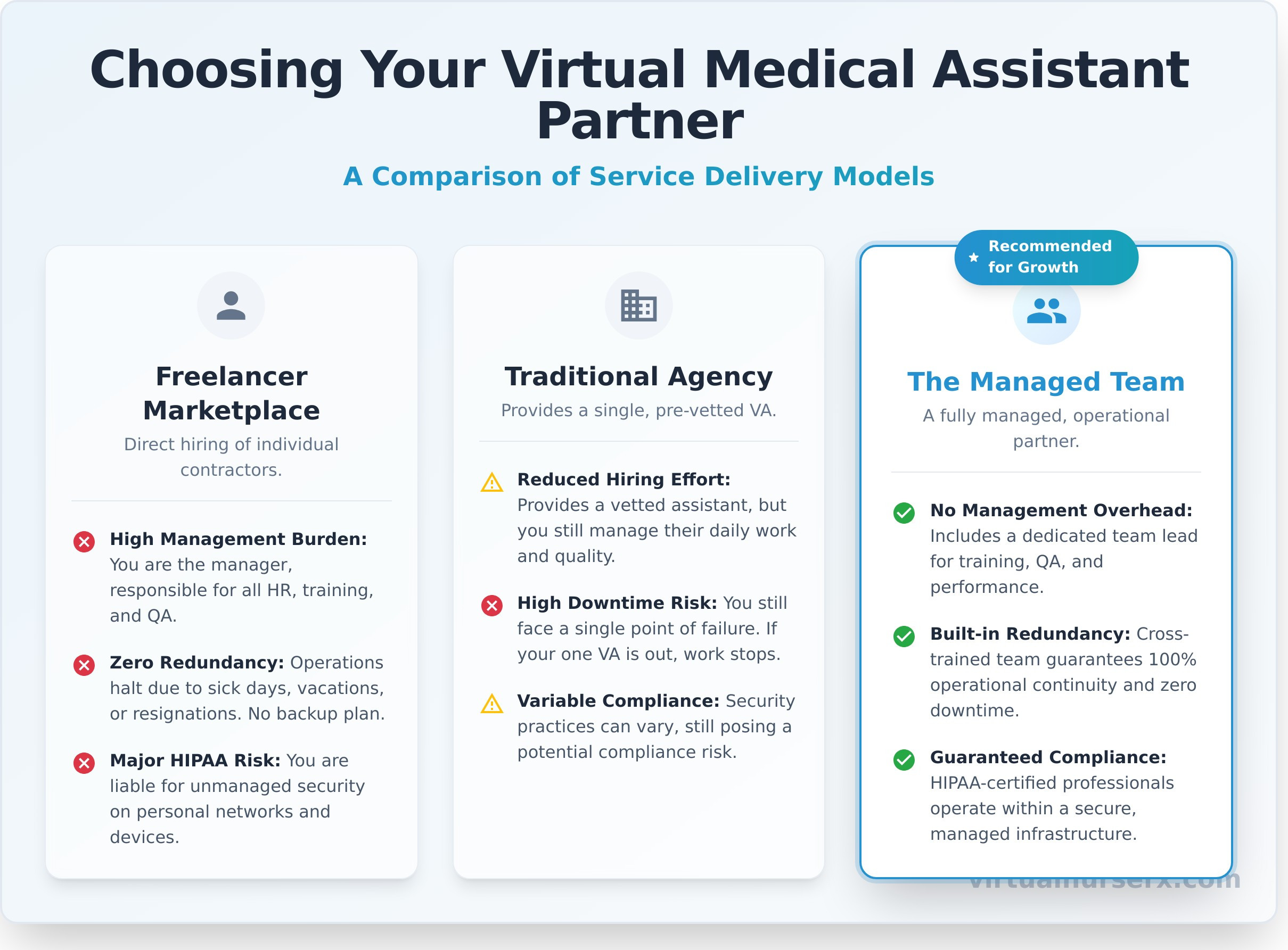
- The Freelancer Marketplace: Platforms that connect you directly with individual contractors. You are responsible for all vetting, hiring, training, and management.
- The Traditional Agency: A staffing model that provides a single, pre-vetted virtual assistant. While less risky than a marketplace, you still face downtime if your VA is sick or resigns.
- The Managed Team: A comprehensive partnership that provides a fully managed, cross-trained clinical team. This model, the foundation of Virtual Nurse Rx, delivers built-in redundancy, quality assurance, and zero operational downtime.
Comparing VMA Models: Freelancers vs. Agencies vs. Managed Teams
Choosing how to integrate virtual support is the single most critical operational decision a practice owner can make. It's the difference between adding a temporary helper and deploying a strategic asset. While many virtual medical assistant companies offer seemingly similar services, the underlying operational model determines whether you reduce your workload or simply trade one set of problems for another. Understanding the total cost of ownership (beyond a simple hourly rate) is key.
The Freelancer & Traditional Agency Model: A Recipe for Management Headaches
The appeal is obvious: a low hourly rate and direct control. The problem? You've just created a new, high-stakes management job for yourself. This model burdens you with the exact operational tasks you were trying to escape. The hidden costs quickly outweigh the initial savings.
- You Are the Manager: You are solely responsible for onboarding, training, quality assurance, and all HR-related issues. Your time is your practice's most valuable asset, and this model consumes it.
- Zero Redundancy: When your freelancer calls in sick, goes on vacation, or quits, your critical workflows grind to a halt. There is no backup plan.
- Significant Security & Compliance Risks: Are they working on a secure network? Is their computer protected? A solo freelancer is a massive, unmanaged HIPAA liability.
The Managed Team Model: The Strategic Choice for Growth and Reliability
This isn't about hiring a person; it's about integrating a system. A managed team functions as a true operational partner, designed to deliver consistent results without requiring your direct oversight. It's the only structure that solves the core challenge of delegation: ensuring work is done correctly and reliably, every single time.
Instead of adding to your plate, a managed team removes the systemic healthcare administrative burdens that prevent practices from scaling. This is achieved through a fundamentally superior structure that includes:
- A Dedicated Team Lead: A professional manager oversees training, quality assurance, and performance, working to meet your standards without requiring your intervention.
- Built-in Backup: Our model includes fully-trained backup staff, providing continuity-focused coverage for your practice when conditions allow.
- Compliance Focus: Every team member completes documented HIPAA training and works within our secure, managed infrastructure.
Stop managing assistants. Start scaling your practice. The Managed Team model is the definitive choice for healthcare leaders focused on growth, efficiency, and peace of mind.
8 Critical Criteria for Choosing Your Virtual Medical Assistant Partner
Not all virtual medical assistant companies are created equal. The right partner becomes a seamless extension of your team, driving efficiency and growth. The wrong one creates more management headaches. Use this checklist during your research to separate the true operational partners from the simple staffing agencies.
1. Healthcare Background: Are Their VAs Healthcare-Educated?
There is a significant difference between a general administrative assistant and a clinical professional. A VA without a medical background can handle scheduling but lacks the context to route patient concerns correctly or manage prior authorizations effectively. Healthcare-educated VAs understand clinical nuance, which reduces critical errors and ensures patient interactions are handled with expertise. Don't settle for less.
Key Question: What are the minimum qualifications for your virtual assistants?
2. Redundancy: What is Your Protocol for Sick Days and Vacations?
Hiring a solo VA creates a single point of failure in your operations. If they get sick, take a vacation, or quit, your practice grinds to a halt. A premier partner has a team-based model with built-in redundancy. This means VAs are cross-trained on your practice's workflows, ensuring seamless coverage and operational continuity, no matter what.
Key Question: How do you handle backup coverage when a primary VA is unavailable?
3. Management & QA: Who Manages the VA's Performance?
Most agencies leave the most time-consuming work to you: management, training, and quality assurance. This model doesn't save you time; it just trades one set of tasks for another. A managed service provides a dedicated Team Lead who actively monitors performance, optimizes workflows, and ensures tasks are completed to the highest standard. This allows you to focus on patient care, not personnel management.
Key Question: Do you provide a dedicated manager for quality control?
4. Compliance: How Do You Ensure HIPAA Security?
A simple "we are HIPAA compliant" statement is not enough. True security requires robust, verifiable protocols. Your partner must be willing to sign a Business Associate Agreement (BAA) and use secure, encrypted communication platforms.
Key Question: What specific technical and administrative safeguards do you have in place?
The Virtual Nurse Rx Advantage: The Managed Clinical Team™
Most virtual medical assistant companies simply provide a person; you're still left with the burden of training, management, and quality control. This outdated model creates operational bottlenecks and fails to deliver true scalability. We knew there had to be a better way. The Managed Clinical Team™ isn't just a service. It's a complete operational solution designed to integrate seamlessly into your practice and drive growth from day one.
Why We Built the Managed Clinical Team™ Model
We saw the documented failures of the traditional VA model: inconsistent performance, high turnover, and a constant drain on your time. That's why we built a system where we are your operational partner, not just a staffing agency. Our focus is on delivering consistent, high-quality outcomes (like enhanced efficiency and predictable scalability) not just selling you hours. We handle the management so you can focus on patient care and strategic growth.
Our Continuity-Focused Backup Coverage Model: How It Works
Practice continuity is non-negotiable. Our unique team structure eliminates the risk of operational disruption caused by staff absence. Every client is supported by:
- A Primary Virtual Assistant: Your dedicated, day-to-day healthcare-educated professional.
- A Cross-Trained Backup VA: Fully versed in your practice's Standard Operating Procedures (SOPs) and ready to step in instantly.
- A Dedicated Team Lead: Oversees performance, quality assurance, and ensures seamless coverage.
This built-in redundancy is designed to keep your administrative tasks covered, protecting your revenue and patient experience.
Staffed by Medically Trained, Healthcare-Educated Professionals
Unlike other virtual medical assistant companies that hire generalist administrators, our teams are composed of medically trained, healthcare-educated professionals. This healthcare-first approach is our greatest advantage. Your VA doesn't just follow a script; they understand medical terminology, clinical workflows, and the nuances of patient interaction. This expertise translates directly to fewer errors, improved patient satisfaction, and the ability to handle complex tasks with confidence. See how our clinical teams can transform your practice.
Your Practice Deserves More Than a VA, It Deserves a System
Choosing the right partner from the crowded field of virtual medical assistant companies is a critical decision for your practice's future. The key takeaway is clear: not all support is created equal. Moving beyond the limitations of freelancers or basic agencies toward a managed model is essential for true operational efficiency and growth. It's about implementing a reliable system, not just hiring remote help.
Virtual Nurse Rx delivers that system. Our proprietary Managed Clinical Teams™ are staffed by medically trained, healthcare-educated professionals, ensuring strong healthcare fluency. We provide a continuity-focused backup coverage model and a HIPAA-trained team, with a BAA available when required before PHI access, to give you peace of mind. Stop adding to your management burden and start scaling your practice with a partner who handles it all.
Ready to see the difference a true clinical partner can make? Stop Managing VAs. Book Your Free Strategy Call Today. The path to a more efficient, scalable practice is clearer than ever.
Frequently Asked Questions
What is the typical cost of a virtual medical assistant company?
The cost of virtual medical assistant companies varies based on the level of support and clinical expertise required. At Virtual Nurse Rx, we provide customized pricing for our Managed Clinical Teams™ to align with your practice's specific operational goals. Our model is designed to deliver significant cost savings (often up to 70%) compared to hiring, training, and managing traditional in-house staff. This allows you to reallocate resources from administrative overhead to direct patient care and practice growth.
How long does it take to onboard with a service like Virtual Nurse Rx?
Our deployment process is engineered for speed and precision. Following our initial Clinical Operations Risk Assessment™, we can typically have your dedicated Managed Clinical Team™ fully onboarded and integrated into your practice within 7 to 14 business days. This accelerated timeline ensures you experience the benefits of optimized workflows and reduced administrative burden almost immediately, minimizing disruption and maximizing your return on investment. We handle all the setup so you can focus on your patients.
Can virtual medical assistants work with my specific EMR/EHR system?
Absolutely. Our documentation-support specialists are proficient with all major EMR/EHR platforms, including Epic, Cerner, eClinicalWorks, Athenahealth, and many more. As part of our meticulous onboarding process, we ensure your team is trained specifically on your system's interface and your practice's unique documentation protocols. This EMR-agnostic approach supports seamless integration and immediate productivity, regardless of the software you use to manage patient records and clinical data.
What's the difference between a virtual medical assistant and a medical scribe?
While a medical scribe primarily focuses on real-time charting during patient encounters, a virtual medical assistant from Virtual Nurse Rx provides comprehensive administrative support. Our team members manage a wider range of critical tasks, including prior authorizations, prescription refills, appointment scheduling, and patient follow-ups. They function as an integrated part of your operational staff, actively optimizing workflows beyond simple documentation to enhance overall practice efficiency and patient care.
How do you handle training on my practice's specific workflows and SOPs?
We don't just follow your workflows. We document and optimize them. Our process begins with a comprehensive discovery phase where we map out your existing procedures. From there, we create detailed, practice-specific Standard Operating Procedures (SOPs) for your dedicated team to follow. This ensures complete consistency and eliminates operational gaps. Our managers oversee this training and provide continuous quality assurance, guaranteeing your team operates as a seamless extension of your practice.
Related Resources
- Medical Virtual Assistant Services
- Managed Clinical Teams
- Solo Provider Support
- Prior Authorizations
Ready to optimize your practice operations?
Take our assessment or book a call to discuss your needs.
Related Services
Medical Virtual Assistant
Comprehensive virtual assistant services.
Solo Provider Support
Tailored support for solo practitioners.
Managed Clinical Teams
Full-service clinical team support.
Available Nationwide
Our HIPAA-compliant virtual assistants serve healthcare practices across the United States.
Ready to Transform Your Practice?
Take our free Clinical Operations Risk Assessment™ and get personalized recommendations.
This content is for general information only, not medical, legal, or billing advice. Virtual Nurse Rx provides administrative support only; clinical decisions remain with licensed providers. Results described are individual experiences and are not guaranteed.