

Is the weight of clinical documentation fueling physician burnout in your practice? Every hour spent on notes is an hour lost with patients, creating operational drag and increasing the risk of inaccurate records. It's a costly problem that demands a strategic solution. This is where high-caliber medical transcription services transform your workflow, offering a direct path to reclaiming valuable time while ensuring pristine, error-free documentation that protects both your patients and your practice.
But navigating today's options (from AI platforms to human scribes) can be complex. How do you ensure seamless EMR integration and ironclad HIPAA compliance without adding more overhead? This definitive guide provides the answers. We'll break down the critical factors for choosing a service, from accuracy benchmarks to security protocols, so you can implement a cost-effective documentation solution that reduces administrative workload and lets your clinical staff focus on what matters most: patient care.
What Are Medical Transcription Services? (And Why They Still Matter)
In an era of increasing automation, it's easy to assume that traditional healthcare roles are becoming obsolete. However, professional medical transcription services remain a critical component of a high-functioning, compliant medical practice. At its core, medical transcription is the specialized process of converting voice-recorded medical reports dictated by physicians and other healthcare providers into accurate, formatted text documents.
But its role extends far beyond simple dictation. Today, transcription is essential for documenting telehealth sessions, patient consultations, and even clinical research notes. This process creates the foundational data that populates a patient's Electronic Medical Record (EMR) or Electronic Health Record (EHR). An accurate transcription ensures data integrity throughout the entire healthcare data lifecycle, directly impacting patient safety, billing accuracy, and continuity of care.
The Core Process: From Voice to Verifiable Record
The journey from a spoken observation to a permanent patient record is a meticulous, multi-step process designed for maximum accuracy. It begins with the clinician capturing audio, whether through a dictaphone, a secure mobile app, or a recorded telehealth call. A trained medical transcriptionist then converts the audio into text, navigating complex terminology and accents. The document undergoes a rigorous quality assurance (QA) review by another professional to verify accuracy before being securely delivered and integrated directly into the patient's chart.
Commonly Transcribed Medical Reports
While the types of documentation can vary by specialty, transcriptionists are essential for creating a wide range of legally and clinically significant reports. These documents form the backbone of a patient's medical history. The most common reports include:
- History and Physical Reports (H&Ps): Comprehensive documents detailing a patient's medical history and current physical state.
- Operative Reports: A detailed account of a surgical procedure, from pre-op to post-op.
- Consultation Letters and SOAP Notes: Communications between specialists and referring physicians, or structured notes on patient encounters.
- Discharge Summaries: A clinical summary of a patient's hospital stay, crucial for post-discharge care.
- Psychiatric Evaluations: In-depth notes from mental health assessments and ongoing therapy sessions.
The Modern Dilemma: AI Transcription vs. Human Expertise
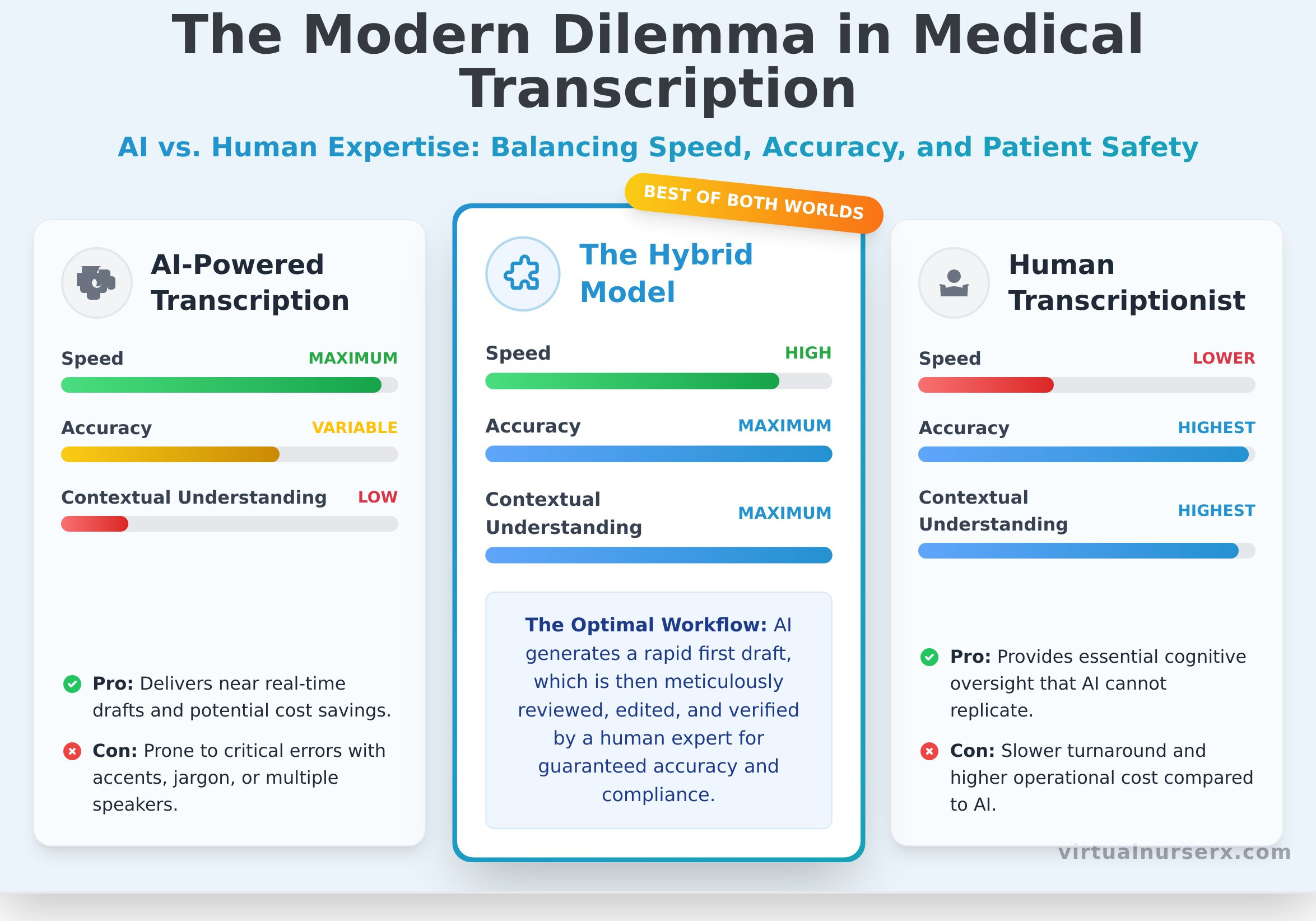
The healthcare landscape is rapidly adopting technology, and documentation is no exception. The rise of AI scribes and automated speech recognition (ASR) promises incredible efficiency, forcing practices to question the role of traditional medical transcription services. While AI delivers impressive speed, it introduces a critical variable: risk. The debate isn't just about technology; it's about balancing operational efficiency with the non-negotiable demand for clinical and legal accuracy.
The Promise and Pitfalls of AI-Powered Transcription
Automated platforms offer a compelling value proposition, transcribing physician dictations in near real-time. However, this speed often comes at the cost of precision. The technology's limitations become clear in real-world clinical settings.
- Pro: Unmatched speed and the potential for significant cost savings on documentation.
- Con: Prone to critical errors when processing heavy accents, complex medical jargon, or conversations with multiple speakers.
- Con: Lacks the cognitive ability to interpret context, understand nuance, or flag a dictated statement that contradicts other information in a patient's chart.
When a Skilled Human Transcriptionist is Irreplaceable
In high-stakes medical documentation, there is no room for error. An experienced human transcriptionist provides a layer of cognitive oversight that AI cannot replicate. This is especially vital when handling complex specialties like cardiology or psychiatry, where nuance is critical. Furthermore, ensuring meticulous accuracy is essential for medico-legal reports, insurance claims, and maintaining strict HIPAA compliance, where a single misunderstood word can have severe consequences. A human expert provides an essential final check for quality, consistency, and common sense.
The Hybrid Model: Is It the Future?
The most effective solution isn't a choice between AI and human, but a strategic integration of both. The hybrid model leverages AI to produce a rapid first draft, significantly boosting efficiency. This draft is then reviewed, edited, and finalized by a professional medical transcriptionist. This approach optimizes the workflow by combining the speed of automation with the indispensable accuracy, contextual understanding, and quality assurance of human expertise. It delivers the best of both worlds: operational speed without compromising patient safety or legal integrity.
Why Accuracy & HIPAA Compliance Are Non-Negotiable
In healthcare, there is no margin for error. While efficiency and cost-savings are critical for a thriving practice, they cannot come at the expense of patient safety or data security. This is the fundamental principle that separates standard administrative support from professional medical transcription services. When dealing with patient health, accuracy and compliance are not features. They are the absolute foundation of quality care.
The High Cost of Inaccuracy in Healthcare
A single transcription error can have devastating consequences. A mistyped dosage, a misunderstood diagnosis, or an omitted allergy can directly lead to adverse patient outcomes. While technology continues to evolve, automated systems still carry risks of significant errors. Beyond the grave clinical implications, the operational fallout is severe. Inaccurate records can trigger malpractice lawsuits, lead to insurance claim denials, and irreparably damage your practice's reputation and the trust you've built with your patients.
What to Look For in a HIPAA-Compliant Service
Claiming to be "HIPAA compliant" is easy; proving it requires a robust operational framework. A truly secure partner goes far beyond basic promises and implements strict, auditable security measures. When evaluating medical transcription services or any third-party documentation support, demand evidence of a comprehensive security posture. Key indicators include:
- Signed Business Associate Agreements (BAAs): A BAA is a legal contract that obligates the service provider to protect your patients' Protected Health Information (PHI) according to HIPAA standards. It is non-negotiable.
- End-to-End Encryption: All data, whether in transit or at rest, must be encrypted to prevent unauthorized access during file transfers and storage.
- Secure, Audited Platforms: The provider must use secure platforms and undergo regular security audits. This includes vetting all personnel with thorough background checks.
- Clear Data Protocols: Ask for clear, documented procedures for how PHI is handled, accessed, stored, and ultimately destroyed.
A mistake in a patient chart is not an option. See how our clinical teams ensure accuracy.
Integrating Transcription into a Streamlined Clinical Workflow
Viewing medical transcription as just a dictation task is a critical operational mistake. In a high-performing practice, transcription is not an endpoint; it is the starting point for your entire administrative and revenue cycle. A meticulously transcribed note is the first domino that triggers billing, insurance verification, and prior authorizations. Without it, your workflow grinds to a halt.
From Transcribed Note to Paid Claim
The journey from a patient encounter to a paid claim begins with documentation. An accurate transcript provides the structured data needed to generate a superbill, submit a claim, and justify medical necessity to payers. Delays or errors at this initial stage create costly bottlenecks. A single coding error originating from a misheard term can lead to claim denials, appeals, and wasted staff hours, directly impacting your practice's revenue cycle health.
The Power of a Managed Clinical Team
A simple transcription vendor only solves one piece of the puzzle. This is where a Managed Clinical Team fundamentally changes the equation. Instead of juggling a separate transcriptionist, a virtual assistant for scheduling, and an in-house staffer for insurance calls, you have a single, cross-trained team. This eliminates communication gaps and operational friction. Your dedicated Team Lead provides quality assurance not just on transcription, but across all interconnected administrative tasks.
Reducing Your Administrative Burden by Over 60%
When you stop managing multiple vendors and integrate these functions, the efficiency gains are immediate. A unified system means your physicians are liberated from administrative oversight and can focus entirely on patient care. Our integrated approach to medical transcription services and administrative support is designed to optimize your operations from the ground up. Stop managing tasks and start scaling your practice with a partner built for healthcare. Discover how Virtual Nurse Rx can streamline your workflow.
How to Choose the Right Medical Transcription Partner
Selecting a partner for your medical transcription services is a critical operational decision that directly impacts clinical accuracy, administrative efficiency, and patient safety. Not all providers are created equal. To protect your practice and optimize your workflow, it's essential to perform thorough due diligence. This means asking the right questions and understanding what truly drives value beyond the price tag.
Key Questions for Potential Providers
Arm yourself with a checklist to vet any potential partner. Their answers will reveal their commitment to quality, security, and performance. Essential questions include:
- Accuracy & Quality Assurance: What accuracy rates do you target, how are they measured, and can you detail your multi-level QA process?
- Security & Compliance: How do you ensure end-to-end HIPAA compliance, including data encryption and secure access protocols?
- Turnaround Time (TAT): What are your standard and STAT turnaround times, and how consistently are they met?
- Specialty Experience: Do your transcriptionists have proven experience in my specific medical specialty?
- EMR/EHR Integration: Can you provide seamless, direct integration with our existing EMR/EHR system?
Understanding Pricing: Per Line vs. Per Minute
Pricing for medical transcription services typically falls into two categories. The traditional per-line model charges for each line of transcribed text, which can be difficult to forecast. A per-minute-of-audio model offers more predictable budgeting but may not account for dictation complexity. For practices seeking an all-in-one solution, a managed service model often includes transcription within a flat-rate package, simplifying billing and aligning costs with overall operational support.
Why Staff Qualifications Matter
The clinical background of the transcription team is a non-negotiable factor for high-performing practices. Many transcription services employ staff with clinical backgrounds; at Virtual Nurse Rx, our transcriptionists are medically trained, healthcare-educated professionals. Clinically qualified staff not only produce more accurate transcripts but can also identify potential inconsistencies in dictation, adding a crucial layer of quality control. This expertise translates directly to more reliable patient records and reduced risk for your practice.
Ultimately, the right partner functions as an extension of your clinical team. For a fully integrated approach that combines expert transcription with comprehensive administrative support, explore the benefits of a Managed Clinical Team.
Streamline Your Documentation, Scale Your Practice
Choosing the right partner for your clinical documentation is a strategic decision, not just an administrative one. While technology evolves, the demand for accuracy and strict HIPAA compliance remains constant. Integrating high-quality medical transcription services is a critical first step, but true operational efficiency is achieved when you eliminate the management burden entirely. This is where a managed solution transforms your workflow. Virtual Nurse Rx provides more than a service; we deliver a secure, reliable extension of your team. Staffed by medically trained, healthcare-educated professionals with documented HIPAA training, our Managed Clinical Teams™ offer built-in redundancy and quality assurance, giving you precision without the staffing headaches.
Stop Managing Tasks. Start Scaling Your Practice with a Managed Clinical Team™. The future of your practice is efficient and focused on growth. Let us handle the details.
Frequently Asked Questions About Medical Transcription
How much do medical transcription services typically cost?
Pricing is tailored to your practice's volume and specific needs. Costs are typically structured per line (e.g., 7-14 cents), per minute of dictation, or on a per-report basis. We provide a transparent, customized quote after a brief operational assessment. This ensures you receive a cost-effective solution that optimizes your documentation budget and eliminates unpredictable administrative expenses, maximizing your return on investment.
What is the average turnaround time for transcribed medical reports?
We target standard report delivery within a 24-hour window; actual turnaround varies with volume and dictation quality. For more urgent clinical needs, we offer STAT services that deliver completed transcriptions in as little as 2-4 hours. Our managed workflow is designed to keep documentation from becoming a bottleneck so providers can review and sign off on notes promptly. Results vary by practice. This accelerates the patient care cycle and improves your practice's overall operational velocity.
How do you ensure the confidentiality and security of my patient data?
Protecting patient data is non-negotiable. Our entire platform is fully HIPAA-compliant and HITRUST-certified, utilizing 256-bit AES encryption for all data, both in transit and at rest. Access is governed by strict, role-based controls and multi-factor authentication. Every member of our team undergoes rigorous background checks and continuous security training, ensuring your practice is safeguarded by the industry's highest security and confidentiality standards.
Can your service integrate directly with my practice's EMR/EHR system?
Absolutely. Seamless integration is a core component of our service. Our technology is engineered for direct, secure integration with all major EMR/EHR platforms, including Epic, Cerner, Athenahealth, and eClinicalWorks. Completed transcriptions are automatically populated into the correct patient charts, which eliminates manual data entry, reduces the risk of error, and frees up your staff's valuable time for patient-facing activities.
What qualifications do your medical transcriptionists have?
Our transcription team is composed of medically trained, healthcare-educated professionals who understand medical terminology, clinical workflows, and HIPAA compliance requirements. All staff complete rigorous training, hold relevant certifications such as CMT from AHDI, and undergo regular quality assurance reviews. This ensures accuracy, security, and seamless collaboration with your practice.
What level of accuracy can I expect from your service?
We work toward target accuracy rates of 99% or higher; actual accuracy varies by dictation quality and specialty. Every document undergoes a meticulous, multi-level quality assurance (QA) process. After initial transcription, a senior editor reviews the document against the original audio to verify absolute precision in terminology, grammar, and formatting. This rigorous system ensures the final report is a clinically reliable document that is ready for immediate use in your EMR.
Do you offer services for highly specialized fields like psychiatry or oncology?
Yes. We provide expert medical transcription services across a full spectrum of complex specialties. Our teams include dedicated transcriptionists with extensive, verified experience in fields such as oncology, psychiatry, cardiology, neurology, and orthopedics. Each specialist is proficient in the specific terminology and report formatting unique to their discipline, ensuring even the most technical dictations are transcribed with expert-level precision and context.
Related Resources
- Medical Transcription Services
- Managed Clinical Teams
- Security & Compliance
- Medical Coding & Billing
Ready to optimize your clinical documentation workflow?
Take our assessment or book a call to discuss how we can help.
Related Services
Appointment Scheduling
Streamline your scheduling process with dedicated support.
Insurance Verification
Fast, accurate insurance verification for your practice.
Medical Coding & Billing
Expert billing support to maximize your revenue cycle.
Available Nationwide
Our HIPAA-compliant virtual assistants serve healthcare practices across the United States.
Ready to Transform Your Practice?
Take our free Clinical Operations Risk Assessment™ and get personalized recommendations.
Individual experience; results vary.