

Imagine reclaiming your lunch break. Finishing charts before dinner. Actually seeing the end of your inbox. For most physicians, this sounds like a fantasy. But for a growing number of forward-thinking practices, it's the new reality, thanks to a strategic deployment of a virtual assistant for doctors.
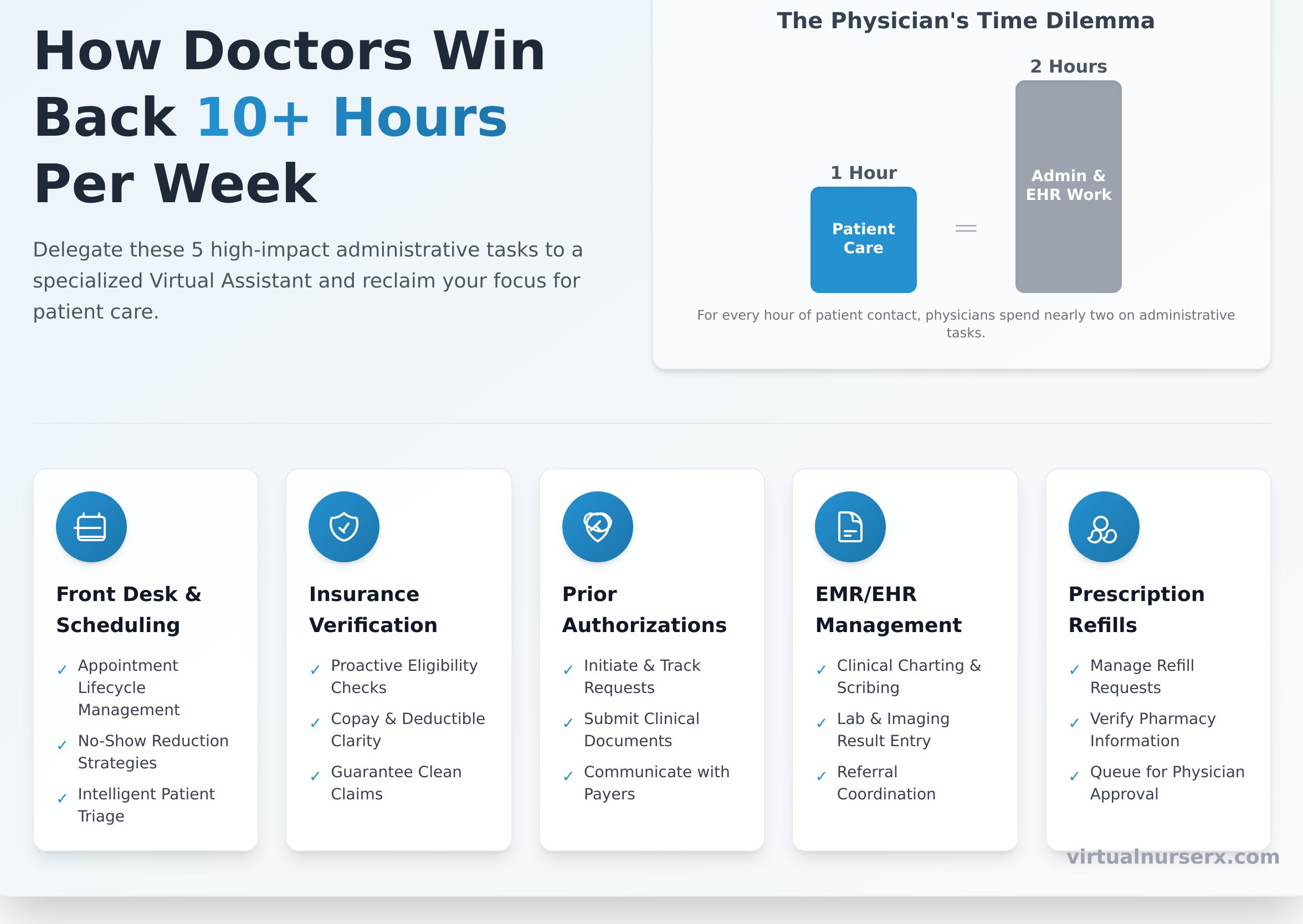
This isn't about offloading a few phone calls. It's about systematically delegating the administrative tasks that are quietly consuming your career and contributing to burnout. A 2023 study from the American Medical Association (AMA) found that physicians spend nearly two hours on <mark>EHR</mark> and desk work for every hour of direct patient care.
The question isn't whether you should delegate. It's what you should delegate first.
This guide breaks down the five most impactful tasks that a qualified medical virtual assistant can take off your plate, starting today. We'll also explore how a Managed Clinical Team model, like the one offered by Virtual Nurse Rx, can provide a more resilient and scalable solution than a solo VA.
Why Doctors Are Drowning in Admin (And Why It Matters)
Before we get to the "what," let's briefly address the "why." The administrative burden on physicians is not a minor inconvenience. It's a systemic crisis with real consequences:
- Burnout: Clerical burden is the leading driver of physician burnout, which now affects over 50% of doctors.
- Revenue Loss: A physician buried in paperwork sees fewer patients. This translates directly to lost revenue.
- Patient Care: When you're exhausted and rushed, the quality of your patient interactions suffers.
A healthcare virtual assistant is designed to address this by functioning as a skilled, remote extension of your practice, handling clinical and administrative workflows from a distance.
The True Cost of Administrative Overload
| Area of Impact | The Problem | The Cost |
|---|---|---|
| Provider Time | 2 hours of admin for every 1 hour of patient care | Seeing 30-40% fewer patients |
| Mental Health | Constant task-switching and inbox anxiety | Burnout, depression, career exit |
| Patient Experience | Rushed appointments, delayed follow-ups | Lower satisfaction, worse outcomes |
| Practice Revenue | Unbilled tasks, coding errors, missed authorizations | Thousands in lost revenue monthly |
Beyond a Generalist: The Power of a Clinically-Trained VA
Not all virtual assistants are created equal. A general-purpose administrative VA may struggle with the nuances of <mark>HIPAA</mark> compliance, medical terminology, and EHR navigation. This is why practices are increasingly turning to services that provide medically trained, healthcare-educated virtual assistants, often Licensed Practical Nurses (LPNs), Registered Nurses (RNs), or even trained medical scribes.
The benefits of clinical training include:
- Faster onboarding: They already speak your language.
- Higher accuracy: Fewer errors in documentation and coding.
- Better patient interaction: Appropriate clinical judgement in patient communications.
- HIPAA fluency: Compliance is second nature, not a learned skill.
Task 1: Mastering the Front Desk & Patient Scheduling
The front desk is the heartbeat of any practice. A single missed call or booking error can cascade into a no-show, a frustrated patient, and a gap in your revenue stream. A dedicated virtual medical receptionist can manage this entire lifecycle.
Appointment Lifecycle Management
A skilled virtual assistant doesn't just answer the phone. They manage the entire appointment journey:
- Booking: Scheduling new and return patients according to your availability rules, procedure durations, and provider preferences.
- Confirmation: Sending automated and personalized reminders via text, email, or phone call.
- Rescheduling: Proactively managing cancellations and filling open slots from a waitlist.
- No-Show Reduction: Following up with patients who miss appointments to understand barriers and reschedule.
By implementing robust appointment scheduling protocols, practices commonly see a 20-30% reduction in no-shows.
Intelligent Call Routing
Your VA can also serve as the first point of contact for incoming patient calls, routing them under your written protocols. They can:
- Route urgent clinical matters to appropriate staff.
- Answer common questions about office policies, locations, and hours.
- Collect preliminary information from new patient inquiries.
- Direct prescription refill requests to the correct workflow.
This ensures that you only handle issues that truly require a physician's attention.
Task 2: Proactive Insurance Verification & Eligibility
Few things are more frustrating than providing a service only to discover the patient's insurance won't cover it. This leads to awkward billing conversations, delayed payments, and sometimes, write-offs.
A proactive approach to insurance verification transforms this from a reactive problem into a solved one.
Before the Patient Arrives
For every scheduled appointment, your virtual assistant should verify:
- Active Coverage: Is the patient's insurance policy currently active?
- Benefit Details: What is their copay, deductible, and coinsurance for the type of visit scheduled?
- Provider Status: Are you listed as an in-network provider for their specific plan?
- Referral Requirements: Does the visit require a referral from a primary care physician?
This information is documented directly in the patient's chart, so your front desk has it the moment the patient checks in.
Task 3: Streamlining Prior Authorizations
If insurance verification is a headache, <mark>prior authorizations</mark> are a migraine. The back-and-forth with payers, the paperwork, the phone trees. It's a notorious time sink that delays patient care.
A dedicated VA can take full ownership of the prior authorization workflow:
- Initiating Requests: Submitting authorization requests for medications, procedures, imaging, and referrals.
- Tracking Status: Monitoring the status of each request and proactively following up.
- Managing Denials: Handling initial denials by providing additional clinical documentation for appeals.
- Documentation: Logging all authorization numbers and approval details in the EHR.
As the AMA notes in its research on medical scribes, offloading documentation-heavy tasks allows physicians to focus on what they do best: practicing medicine.
Task 4: Medical Transcription & Scribing
Clinical documentation is non-negotiable. But it doesn't have to be your job.
A virtual medical scribe can handle documentation in real-time during patient encounters (via HIPAA-compliant audio or video feeds) or asynchronously from your recorded dictations. This is one of the single most impactful ways to reclaim your time.
Live Scribing
Your virtual scribe joins the patient encounter remotely and documents the visit in real-time within your <mark>EHR</mark>.
- Chief Complaint & HPI
- Review of Systems
- Physical Exam Findings (as you dictate them)
- Assessment & Plan
- Orders & Prescriptions
By the time you leave the exam room, your chart is 90% complete. A quick review and signature, and you're done.
Asynchronous Transcription
For providers who prefer to dictate notes after an encounter, medical transcription services offer a powerful alternative. You record your thoughts, and a trained transcriptionist converts them into polished, formatted chart notes within hours.
Task 5: EMR/EHR Records Management
Beyond the encounter note, there's a mountain of other documentation that keeps a practice running. A virtual assistant can become your dedicated back-office expert for all things EHR-related.
Referral Coordination
Managing outgoing and incoming referrals is a multi-step process ripe for delegation:
- Preparing referral packets with relevant clinical history.
- Sending referrals to specialists and confirming receipt.
- Tracking patient appointments with referred specialists.
- Obtaining and filing consult notes back into the primary chart.
Chart Auditing & Maintenance
Clean charts are essential for continuity of care, compliance, and accurate billing. Your VA can conduct regular chart audits to:
- Update patient demographics and emergency contacts.
- Ensure all required documents (consent forms, HIPAA acknowledgments) are on file.
- Reconcile medication lists.
- Flag gaps in care (e.g., overdue screenings).
The Managed Team Advantage: Why Solo VAs Sometimes Fail
Hiring a single, independent virtual assistant can seem like a cost-effective solution. But what happens when they get sick? Go on vacation? Or decide to pursue a different opportunity?
You're right back to square one.
This is why many practices are shifting towards a Managed Clinical Team model. Providers like Virtual Nurse Rx don't just place a single person with you. They provide a team-based approach where:
| Feature | Solo Freelance VA | Managed Clinical Team |
|---|---|---|
| Backup Coverage | None. You're exposed. | Continuity-focused backup coverage. A trained team member steps in. |
| Training & Onboarding | You do it yourself. | The service handles it with clinical protocols. |
| HIPAA Compliance | You must verify and audit. | Baked in. Compliance is the provider's responsibility. |
| Hiring & HR | You recruit, vet, and manage. | Fully managed. You get the output, not the overhead. |
The Managed Clinical Teams approach offers peace of mind that a single freelancer simply cannot provide. Your workflow is protected, your compliance is assured, and your time is consistently freed up.
FAQs
How does a virtual assistant access my EMR securely?
Reputable medical virtual assistant services use enterprise-grade security protocols. This typically involves a <mark>HIPAA</mark>-compliant VPN, multi-factor authentication, and role-based access controls within your EHR. All data transmission is encrypted, and business associate agreements (BAAs) are executed to ensure legal compliance.
What's the difference between a virtual assistant and a virtual scribe?
A virtual scribe is a specialized type of virtual assistant focused almost exclusively on clinical documentation during or immediately after patient encounters. A medical virtual assistant has a broader scope, handling tasks like scheduling, insurance verification, referrals, and patient communication. Some VAs are trained to do both.
How much does a medical virtual assistant cost?
Pricing varies based on experience, clinical training, and scope of work. Generally, a clinically-trained virtual assistant from a managed service will cost more than an overseas generalist but significantly less than a full-time, in-house employee when you factor in benefits, payroll taxes, and overhead. Virtual Nurse Rx offers transparent, per-hour pricing models.
How quickly can a virtual assistant be onboarded to my practice?
A well-organized onboarding process can have a virtual assistant performing core tasks within one to two weeks. This includes EHR training, workflow documentation review, and a period of shadowing or supervised work. Managed services typically have streamlined onboarding protocols to accelerate this timeline.
Are virtual assistants actually clinically trained?
This depends entirely on the provider. A general freelance VA from a gig platform likely has no medical background. However, specialized services like Virtual Nurse Rx employ medically trained, healthcare-educated professionals. This healthcare foundation is what allows them to handle complex administrative tasks like scribing support, prior authorization paperwork, and patient coordination effectively.
Can I get a virtual assistant for my psychiatry or mental health practice?
Absolutely. Virtual assistant support is increasingly popular in mental health and psychiatry settings. VAs can manage therapy appointment scheduling, handle sensitive patient communications with appropriate training, process prior authorizations for psychiatric medications, and assist with clinical documentation for therapy notes and evaluations.
Reclaim Your Time, Reclaim Your Practice
The administrative burden on physicians is real, but it's not insurmountable. By strategically delegating high-impact tasks to a qualified virtual assistant for doctors, you can reclaim over 10 hours per week, time that can be reinvested in patient care, practice growth, or simply your own well-being.
Whether you start with appointment scheduling, prior authorizations, or full medical scribe support, the key is to take the first step.
Ready to see what's possible for your practice?
Take our free 2-minute Practice Assessment Quiz to get a personalized recommendation. Or, if you're ready to talk to a specialist, book a free consultation call with our team today.
Related Services
Medical Virtual Assistant
Comprehensive virtual assistant services.
Solo Provider Support
Tailored support for solo practitioners.
Managed Clinical Teams
Full-service clinical team support.
Available Nationwide
Our HIPAA-compliant virtual assistants serve healthcare practices across the United States.
Ready to Transform Your Practice?
Take our free Clinical Operations Risk Assessment™ and get personalized recommendations.
This content is for general information only, not medical, legal, or billing advice. Virtual Nurse Rx provides administrative support only; clinical decisions remain with licensed providers. Results described are individual experiences and are not guaranteed.