
Is your clinical documentation process a source of constant operational stress? Juggling the demand for perfect accuracy with rising costs can be a significant headache for any practice. Add in the confusion around new technologies like AI, and it's easy to question the value of traditional roles. You might be wondering if hiring a dedicated medical transcriptionist is an outdated, inefficient expense. The answer is a definitive no. This critical role isn't disappearing; it's evolving into a highly specialized function at the core of modern, scalable healthcare operations.
This guide provides the clarity you need. We'll break down the essential skills that support accurate medical records, demonstrate how the role delivers a secure and cost-effective documentation solution, and reveal how it integrates seamlessly into today's virtual clinical teams. You will gain a confident understanding of how this position can optimize your workflow, eliminate documentation errors, and fortify your practice for the future. Stop worrying about your records and start focusing on growth.
What Does a Medical Transcriptionist Actually Do?
A skilled medical transcriptionist serves as the critical link between a physician's spoken words and a patient's permanent health record. Their core function is to convert voice-recorded medical reports (dictated by doctors, nurses, and other healthcare providers) into precise, formatted text documents. This process, known as medical transcription, is far more than simple typing; it is an act of expert interpretation that ensures the absolute integrity of clinical documentation.
The importance of this role cannot be overstated. Accurate records are the non-negotiable foundation of quality patient care, optimized billing cycles, and robust legal compliance. Without this meticulous conversion, vital details can be lost, leading to potential medical errors, claim denials, and significant operational bottlenecks. The transcriptionist effectively builds the bridge between a provider's real-time observations and the structured data required by an Electronic Health Record (EHR), ensuring every diagnosis and treatment plan is captured flawlessly.
The typical workflow is a model of secure efficiency. A provider dictates their notes, the audio file is securely transmitted, and the transcriptionist gets to work. They listen, transcribe, edit, and format the content before delivering a polished, finalized document ready for EHR integration and physician sign-off.
The Day-to-Day Responsibilities
The daily workflow of a medical transcriptionist is a disciplined process focused on precision and speed. Key tasks demand a unique blend of listening skills and medical knowledge:
- Listening & Transcribing: Carefully listening to audio files and accurately transcribing spoken content, often with challenging accents or background noise.
- Interpreting: Deciphering complex medical terminology, abbreviations, and jargon to ensure correct context and spelling.
- Editing: Scrutinizing dictated material for grammatical errors, inconsistencies, and lack of clarity to produce a professional document.
- Formatting: Structuring final documents according to specific clinical, legal, or institutional standards for seamless integration.
Types of Documents They Create
These professionals are responsible for producing a wide range of critical medical documents that form the backbone of a patient's chart. Common examples include:
- History and Physical (H&P) reports
- Consultation notes and referral letters
- Operative reports and post-procedure notes
- Discharge summaries
- Pathology and diagnostic imaging interpretations
The Essential Skillset of a Top-Tier Medical Transcriptionist
Excelling in medical transcription requires far more than rapid typing. A top-tier medical transcriptionist operates at the intersection of clinical knowledge, technical skill, and unwavering professional integrity. This unique combination ensures that spoken medical encounters are transformed into precise, compliant, and actionable clinical documentation, safeguarding both patient care and practice liability.
This role is not an entry-level administrative task; it is a specialized function demanding a deep and diverse skillset. From understanding complex medical language to navigating secure digital health platforms, their expertise is critical to maintaining the flow and accuracy of your practice's most vital information.
Foundational Knowledge and Technical Skills
The bedrock of a great transcriptionist is a comprehensive understanding of the language of medicine. This is combined with the technical agility to work seamlessly within modern healthcare IT environments. Key competencies include:
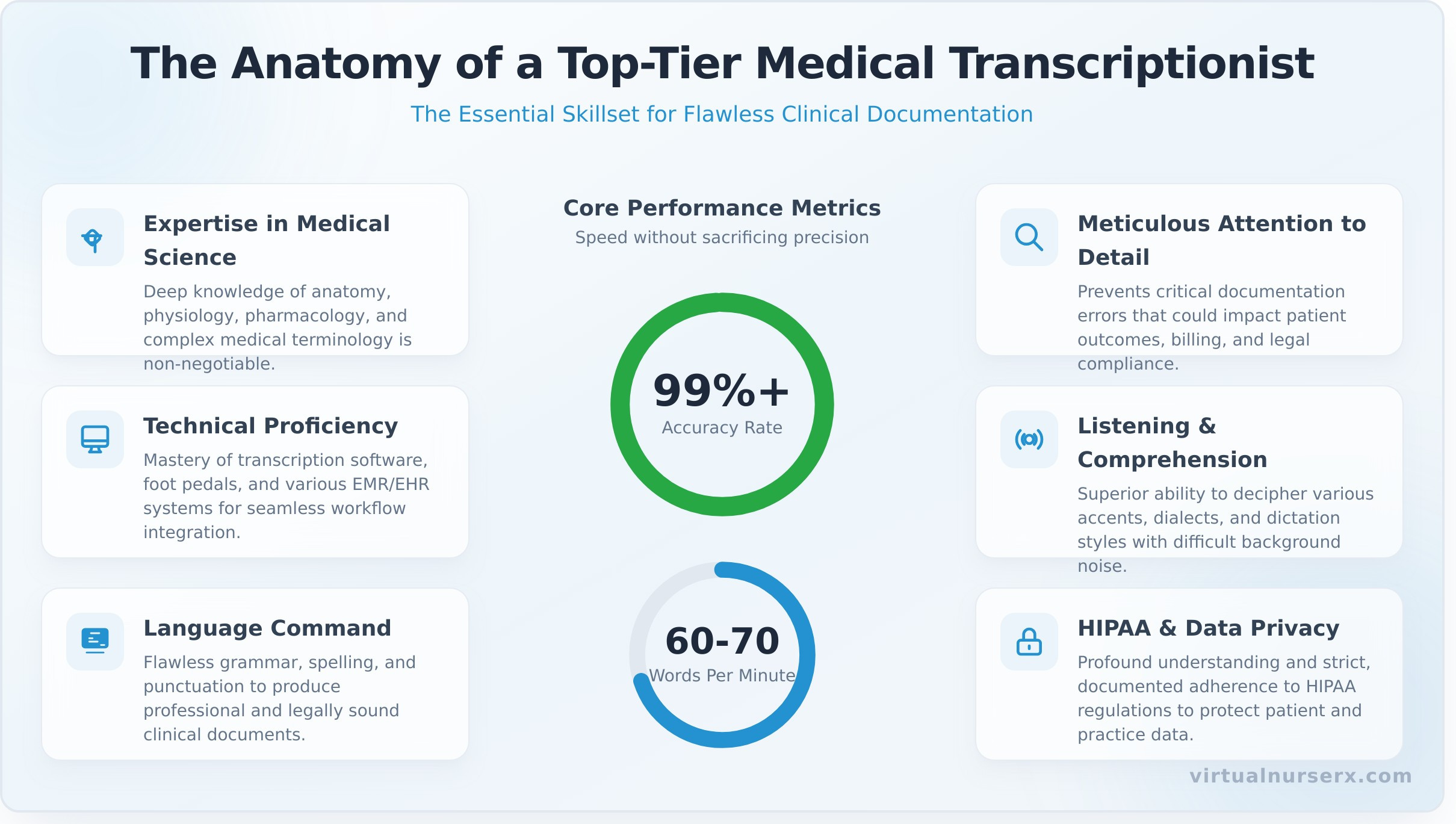
- Expertise in Medical Science: Deep familiarity with medical terminology, human anatomy, physiology, and pharmacology is non-negotiable for accurate interpretation.
- Technical Proficiency: Mastery of transcription software, foot pedals, and various Electronic Medical Record (EMR) or Electronic Health Record (EHR) systems is essential for operational efficiency.
- Language Command: Flawless grammar, spelling, and punctuation are required to produce professional and legally sound documents.
- Speed and Accuracy: While a minimum typing speed of 60-70 words per minute is standard, it is the exceptionally high accuracy rate (often over 99%) that truly defines a professional.
Crucial Soft Skills: Accuracy and Discretion
Beyond technical ability, the role demands a specific set of soft skills centered on precision and confidentiality. A single error can have significant consequences, making these traits paramount. An elite medical transcriptionist demonstrates meticulous attention to detail to prevent critical documentation errors that could impact patient outcomes or billing. They possess superior active listening and comprehension skills to decipher various accents, dialects, and dictation styles. Above all, they have a profound understanding of data privacy and provide strict, documented adherence to HIPAA regulations, protecting your practice and your patients.
Common Education and Certification Paths
Professionals often enter the field through postsecondary programs, earning certificates or associate degrees in medical transcription. While formal paths exist, industry certifications like the Registered Healthcare Documentation Specialist (RHDS) and Certified Healthcare Documentation Specialist (CHDS) signify a proven level of expertise. For a service provider, however, these credentials are just the starting point. Verifiable experience, rigorous quality assurance protocols, and a commitment to ongoing training are what truly deliver reliable and accurate results for your practice.
The Evolution of Transcription: From Typist to Clinical Data Editor
The role of the medical transcriptionist has undergone a significant transformation. The rise of automation has not eliminated this critical function; it has elevated it. Today's professional is not a simple typist but a highly skilled clinical data editor and quality assurance specialist, serving as the final, essential checkpoint for patient record integrity.
This evolution demands a higher level of clinical knowledge and analytical skill, repositioning the role as a vital component of the healthcare revenue cycle and patient safety protocols.
The Impact of Speech Recognition Technology
Speech Recognition Technology (SRT) now handles the initial heavy lifting, converting spoken dictations into a first-draft text. However, this draft is rarely perfect. The software struggles with complex medical terminology, accents, and background noise, leading to frequent and dangerous errors. The modern medical transcriptionist's workflow begins here, focusing on meticulous review and editing. Their expertise is required to correct:
- Incorrect Medical Terms: Confusing "hypotension" with "hypertension."
- Homonyms and Sound-Alikes: Mixing up "ilium" (pelvic bone) and "ileum" (small intestine).
- Formatting and Punctuation: Ensuring the final document is clear, compliant, and professionally structured.
Why 100% Accuracy Still Requires a Human Touch
AI and SRT lack the critical thinking and contextual understanding of a trained human professional. They cannot interpret a physician's accent, understand nuance, or catch a dictated error that contradicts a patient's known history. This is where a skilled professional's value is undeniable. Meticulous human review is essential for clinical documentation.
An expert catches subtle mistakes that software misses, errors that could lead to misdiagnosis, incorrect treatment plans, or significant billing problems. The final sign-off by a human expert is not just a formality; it is a critical step that ensures the legal and clinical integrity of every patient record. Don't risk patient safety on flawed AI. See how our clinical teams ensure accuracy.
Beyond a Single Role: Transcription as a Core Virtual Assistant Skill
In a modern medical practice, efficiency is paramount. While accurate documentation is non-negotiable, hiring a dedicated, single-task medical transcriptionist can create operational drag and unnecessary overhead. The smarter, more scalable solution is to view transcription not as an isolated job, but as a core competency within a multi-talented virtual assistant's toolkit.
This approach transforms a simple administrative task into a component of a comprehensive, streamlined support system, maximizing value and reducing costs.
The Limitations of a Standalone Transcriptionist
Relying on a single-function role introduces significant vulnerabilities and inefficiencies into your workflow. This outdated model often leads to:
- Cost Inefficiency: You pay a full salary or hourly rate even during periods of low dictation volume, resulting in unproductive downtime and wasted resources.
- Administrative Silos: The transcriptionist operates separately from your front-office staff, preventing a unified understanding of patient cases and related administrative needs.
- Zero Redundancy: If your transcriptionist is sick or on vacation, your documentation workflow comes to a complete halt, creating backlogs and delays in patient care.
The Power of an Integrated Documentation Support Team
Imagine a single, cross-trained professional seamlessly handling dictation, scheduling the follow-up appointments mentioned in the note, and processing a related prior authorization. This integrated approach demolishes administrative silos. Your documentation-support VA develops a holistic understanding of patient files, anticipating administrative needs and supporting continuity of care. With a managed team from a provider like Virtual Nurse Rx, you also gain built-in redundancy designed to keep operations running without interruption.
The Strategic Advantage of a Managed VA Service
Shifting from hiring individuals to partnering with a managed service is a strategic move to optimize your practice. You eliminate the immense burden of recruiting, training, and managing administrative staff. Instead, you gain immediate access to a pre-vetted, HIPAA-compliant team of professionals (including RNs and Doctors) who are ready for deployment. This model allows you to scale your support system effortlessly, adding or reducing hours as your practice evolves. It's time to move beyond managing individual tasks and focus on what truly matters: patient care and practice growth.
Stop managing tasks. Start scaling your practice.
From Medical Transcriptionist to Managed Clinical Team
The role of the traditional medical transcriptionist has fundamentally evolved. It's no longer just about typing. It's about managing critical clinical data with precision and technological skill. This evolution reveals a crucial truth: modern healthcare documentation requires a robust, integrated system, not just an individual. Relying on a single specialist creates unnecessary risk and operational friction for your practice.
It's time to elevate your documentation strategy. Virtual Nurse Rx provides a superior solution with our Managed Clinical Teams, delivering flawless accuracy and comprehensive support. All services are overseen by experienced team leads under documented quality-assurance review. With a HIPAA-trained team, HIPAA-focused security processes, and a continuity-focused backup coverage model thanks to built-in team redundancy, you can finally stop managing staff and start scaling your practice. Discover How a Managed Clinical Team™ Can Transform Your Practice's Documentation Workflow.
Frequently Asked Questions
What is the difference between a medical transcriptionist and a medical scribe?
The key difference is timing. A medical transcriptionist works asynchronously, converting pre-recorded audio dictations from healthcare providers into formal medical documents after a patient encounter. In contrast, a medical scribe works in real-time, documenting the patient visit directly into the EHR, either in person or virtually, as the provider conducts the examination. Transcription is a post-encounter task, while scribing is a live-documentation service designed to support the clinician during the appointment.
How much does a medical transcriptionist make?
Compensation for a medical transcriptionist varies based on experience, employment status (freelance vs. direct hire), and specialization. The median annual wage is approximately $30,100. However, skilled transcriptionists working for specialized services or in high-demand fields like radiology or cardiology may command higher rates. The pay structure can be hourly, per line, or a fixed salary, directly impacting earning potential and operational cost for a practice.
Are virtual medical transcription services HIPAA-compliant?
Yes, any reputable virtual medical transcription service must be fully HIPAA-compliant. This is a non-negotiable operational standard. Compliance requires secure, encrypted platforms for all data transfer and storage, strict access controls, and a signed Business Associate Agreement (BAA) with the healthcare provider. This ensures all protected health information (PHI) is handled with the highest level of security and confidentiality, safeguarding both the patient and the practice from liability and data breaches.
How has AI and speech recognition affected the demand for medical transcriptionists?
AI and speech recognition have transformed the role rather than eliminated it. While these technologies can produce a first draft, they often contain errors in context, grammar, and complex medical terminology. This has shifted the demand for the traditional medical transcriptionist toward a quality assurance role, often called a "medical editor." These professionals are now critical for reviewing, editing, and finalizing AI-generated text to ensure 100% accuracy, which is essential for patient safety and proper billing.
Do you need a specific certification to be a medical transcriptionist?
While state licensure is not required, professional certification is the industry standard for demonstrating competence and is highly preferred by employers. Certifications like the Registered Healthcare Documentation Specialist (RHDS) and the Certified Healthcare Documentation Specialist (CHDS) validate an individual's expertise in medical terminology, anatomy, and documentation standards. For a practice, hiring certified professionals minimizes errors and ensures a higher quality of clinical documentation from day one.
Can medical transcriptionists work from home?
Absolutely. Working from home is the predominant model for medical transcription. This provides practices with a flexible and scalable staffing solution without the overhead costs of an in-office employee. Through secure, cloud-based platforms and encrypted networks, remote transcriptionists can safely access audio files and submit completed reports while maintaining strict HIPAA compliance. This remote capability allows healthcare providers to access a nationwide talent pool to find the best fit for their needs.
Related Resources
- Medical Transcription Services
- Managed Clinical Teams
- Medical Virtual Assistant
- Prior Authorizations
Ready to optimize your clinical documentation workflow?
Take our assessment or book a call to discuss how we can help.
Related Services
Appointment Scheduling
Streamline your scheduling process with dedicated support.
Insurance Verification
Fast, accurate insurance verification for your practice.
Medical Coding & Billing
Expert billing support to maximize your revenue cycle.
Available Nationwide
Our HIPAA-compliant virtual assistants serve healthcare practices across the United States.
Ready to Transform Your Practice?
Take our free Clinical Operations Risk Assessment™ and get personalized recommendations.
This content is for general information only, not medical, legal, or billing advice. Virtual Nurse Rx provides administrative support only; clinical decisions remain with licensed providers. Results described are individual experiences and are not guaranteed.